Is Lovable.dev SEO Friendly? A Guide to Getting Your Site Ranked (2026)
Lovable.dev builds great UIs fast, but SEO is its biggest weakness. We tested the Reddit myths, explain why SPAs can't rank without help, and show you the two fixes that actually work - including for AI search engines like ChatGPT and Perplexity.
Lovable.dev is good at a lot of things. It excels at building nice-looking UIs with a prompt in minutes and creating basic functioning apps with Supabase or Lovable Cloud. However, SEO is not one of Lovable's strong suits — which is also why teams keep asking Lovable vs WordPress for new builds, and what to make of Lovable's recent SEO update with TanStack SSR, native prerendering, and the Semrush connector.
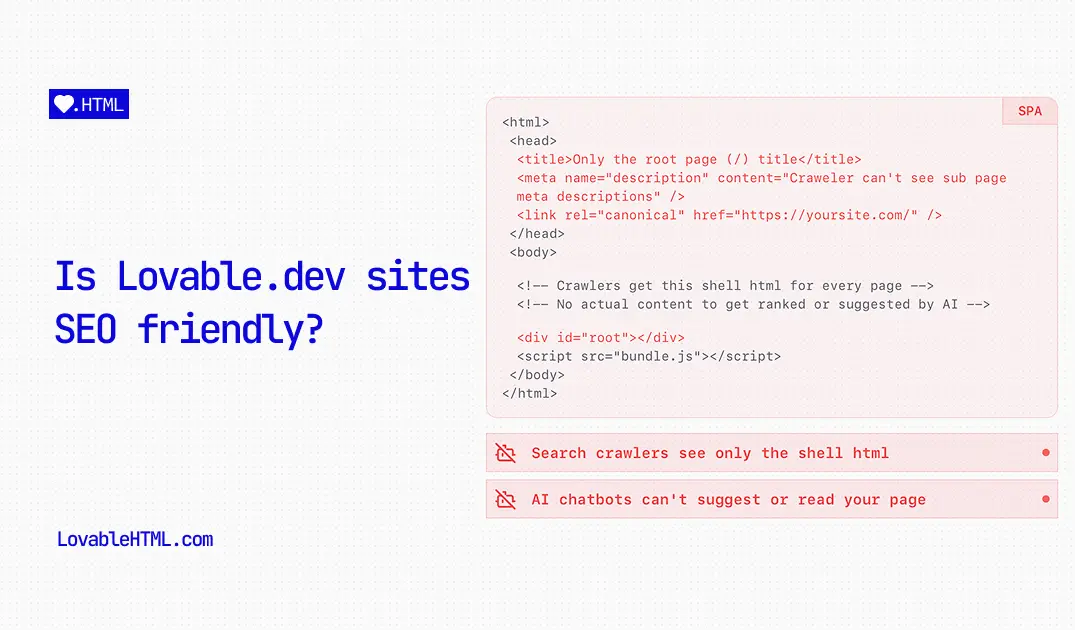
For a site or a page to rank for the keywords included in its content, it has to be fully crawlable by search engines. Since Lovable can only build client-side rendered, React Single Page Applications (SPAs), your content is only available when visited in a browser. This is because SPAs use JavaScript to render content. Most search engine crawlers either will not wait for the JavaScript to execute and load the content, or they do not crawl JavaScript-rendered pages at all, only receiving the basic shell from your index.html file.
Popular myths
If you type in on reddit "Lovable SEO", you will see a bunch of discussions of people trying to find solutions to this exact problem. Some people are realizing that it's not possible to fix and others, for whatever reason, proud to claim that they have found this magic prompt that fixes all your SEO problems. So I decided to take on this job of verifying if those claims are legit or misleading.
"You can prompt Lovable to do it".
This one is easy to verify. Just run the prompt they claim to have found fix your issues and do a curl or crawler simulator test on your site after, you find out that it's straight BS and your page still renders <div id="root"></div> only.
You cannot change Lovable.dev made website to support static site generation or server
side rendering with just prompting, does not matter how nicely you ask it. These
magic prompts people claim to have found can not do anything more
than adding meta tags and JSON+LD schemas. Lovable does not allow any kind
of modification to React SPA sites it makes. Even if you try and port your code over to github and
change it manually to use vite-ssg or Next.js for example, your Lovable preview breaks and
you can no longer make changes to your site using it or publish your changes. Same goes for if you modify anything in your
build command in package.json or build config in vite.config.ts files. Your
site will fail to publish and will not render the preview, it just stops working. Lovable.dev
can only build React single page applications and that's it.
"Crawlers can easy crawl SPAs and execute JavaScript".
That's not true. Only some crawlers execute JavaScript but slow, within limited time and it is not guaranteed. Running headless browsers which is essentially a crawler is not a cheap compute task. Most crawlers execute JavaScript slower than your typical user browser so crawler may not execute complex JavaScript logic or wait until all page content finished rendering before the Googlebot times out and leaves. This causes flaky content with your internal links and page content are read fully or not loaded at all.
"All my pages are indexed on Google.".
This is a common misconception as well. Pages indexed does not equal your content is indexed. When you submit your sitemap on search console, Googlebot will visit all urls submitted in there. If it sees some kind of content, it will mark the url indexed. Google now knows url exists. What it does not know however is your content in its full form, keywords your content may rank for or your internal links. If you are not serving your pages in static HTML and leaving rendering your content up to crawlers of search engines and AI, quality of indexed content from your site is not guaranteed to be exact same as you see in your browser.
"AI search engines like ChatGPT can read my Lovable site".
This is the newest myth and it is the most damaging one. ChatGPT, Perplexity, Claude, and other AI search engines use their own crawlers to fetch your pages. Unlike Googlebot, which at least attempts to execute JavaScript (slowly and unreliably), most AI crawlers do not execute JavaScript at all.
Here are the crawlers that matter:
| Crawler | Platform | Executes JavaScript? |
|---|---|---|
| OAI-SearchBot | ChatGPT Search | No |
| GPTBot | OpenAI training | No |
| PerplexityBot | Perplexity | No |
| ClaudeBot | Claude | No |
| Applebot | Apple Intelligence | Limited |
| Google-Extended | Gemini | Yes (via Googlebot) |
When any of these crawlers visit your Lovable site, they get the same empty <div id="root"></div>. Your content, your product descriptions, your blog posts - none of it exists from their perspective.
This means your Lovable site cannot be cited by ChatGPT, cannot appear in Perplexity answers, and cannot be referenced by Claude. Even if someone asks these AI tools specifically about your product by name, the AI cannot read your pages to give an accurate answer. It will either say it does not know or pull information from third-party sources where you have no control over the narrative.
With prerendering enabled, all of these crawlers receive complete HTML. Your content becomes available for AI citation immediately.
For a full guide on AI search optimization, see How to Get Your Pages Indexed by ChatGPT, Perplexity, and AI Search Engines.
What's the solution, then?
There are 2 ways I found consistently work while trying to fix this for my freelance clients of my solo fractional software development agency.
- Migrate off of Lovable to use another framework that supports server side rendering.
- Use a pre-rendering proxy to serve SEO / LLM optimized HTML version of your site to crawlers.
Solution 1: Migrate the Lovable Site to SSR or SSG
This solution is to migrate your site from Client-Side Rendering (CSR) to Server-Side Rendering (SSR) or Static Site Generation (SSG). This is a technical process and requires some programming knowledge to debug potential issues.
There is a big caveat, however. After the migration, you can no longer use Lovable to make changes. Since Lovable only supports single-page applications, your site will no longer work in the Lovable editor: you cannot see previews, and Lovable AI's code quality will drop significantly since it is not trained on that kind of codebase.
Solution 2: Use a Prerender Proxy
This problem is not new; it has existed since the introduction of ReactJS in 2014. Solutions from back then still work for this use case. A prerender proxy intercepts requests to your site from crawlers and serves them a pre-rendered, static HTML version of your page.
There are two main providers of this service:
-
Prerender.io: One of the older players in the industry, often used by legacy codebases. It requires code to set up, and your site has to be connected to Cloudflare. Pricing starts at $49/month.
-
Encited: A more recent player and a no-code alternative to Prerender.io. It is specifically built for AI website builders and is more commonly used by non-technical people because of its no-code nature. It starts at
$9/monthand supports AEO (Answer Engine Optimization), a more recent trend in search.
How does pre-rendering work?
When your site is connected to one of the pre-rendering solutions like Encited.com, it will pre-render all your pages defined in your sitemap into SEO / LLM optimized HTML/CSS and store them, ready for search or AI crawler requests come in. When crawlers visit your site looking for content, instead of the shell html (the root div), they will receive the already pre-rendered, SEO / LLM optimized HTML/CSS version of your pages with all your content in it, ready to rank for keywords and to be read by AI chatbots.
Which in turns boosts your traditional search and AEO rankings.
Quick SEO Checklist for Lovable Sites
If you are not sure where you stand, run through this. The items are split by what you can do right now versus what requires prerendering to actually take effect.
Works without prerendering (do these first):
- Create a
robots.txtin/publicthat allows all crawlers including AI bots (OAI-SearchBot,PerplexityBot,ClaudeBot) - Generate an accurate
sitemap.xml- if you have more than 10-15 pages, use a script-based approach to avoid Lovable hallucinating URLs - Submit sitemap to Google Search Console
- Submit sitemap to Bing Webmaster Tools (important for ChatGPT visibility since ChatGPT Search uses Bing's index)
Set up now, but invisible to crawlers without prerendering:
- Per-page meta tags via
react-helmet-async(unique titles and descriptions per page) - Canonical URLs pointing to your custom domain, not
your-app.lovable.app - Open Graph tags for social media previews (LinkedIn, Twitter, Slack)
- JSON-LD structured data (Organization on homepage, Article on blog posts, FAQ where applicable)
- One H1 per page with proper heading hierarchy
- Descriptive alt text on all images
Only works after enabling prerendering or migrating to SSR:
- Content visible to Google, Bing, and AI crawlers
- Social media link previews display correctly
- Internal links discoverable for PageRank flow
- Consistent, reliable indexing (no flaky partial renders)
- Visible to ChatGPT, Perplexity, Claude for AI citations
Test where you stand right now with our free crawler simulator.
What's an SPA (Single Page Application)?
A Single Page Application (SPA) is a website or web application that loads a single HTML page and then dynamically updates the content as a user interacts with it. Instead of loading entirely new pages from the server for each action, it rewrites the current page with new data. This creates a faster, more fluid user experience that feels similar to a desktop application. Frameworks like React, which Lovable.dev uses, are primarily used to build SPAs.
What does AEO stand for?
AEO stands for Answer Engine Optimization. It is an evolution of traditional SEO. While SEO focuses on ranking for keywords, AEO focuses on optimizing content to provide direct answers to user questions. The goal is to have your content featured in rich results like Google's "People Also Ask" boxes, featured snippets, voice search answers (from assistants like Siri or Alexa), and in the responses of AI chatbots.
What's AJAX SEO?
AJAX SEO refers to the set of practices and challenges related to making content loaded with AJAX (Asynchronous JavaScript and XML) crawlable and indexable by search engines. This is essentially the predecessor to the modern SPA/SEO problem. In the past, Google even supported a specific "hash-bang" #! URL scheme to help its crawlers find and render AJAX-driven content, though this method is now deprecated and favor of solutions like pre-rendering or server-side rendering.
How can I check if my site is an SPA or if it is crawlable?
You can test how a search engine crawler sees your site by using our free crawler simulator or a via your terminal using the curl command. To use the curl command, open a terminal (on macOS or Linux) or a command prompt with curl installed (on Windows) and run the following command, replacing https://your-website.com with your site's URL:
curl -i -A "Mozilla/5.0 (compatible; Googlebot/2.1; +http://www.google.com/bot.html)" -H "Accept: text/html" https://your-website.com
After running the command, inspect the HTML output in your terminal.
- If you see your page's text content, headings, and links within the HTML, your site is being served in a way that is crawlable.
- If you see a mostly empty <body> tag with just a
<div id="root"></div>with no content in them exceot a few <script> tags, it confirms your site is a client-side rendered SPA and crawlers are likely not seeing your content.
Frequently Asked Questions
Is Lovable good for SEO?
Lovable has the SEO features you need - per-page meta tags, structured data, sitemaps, clean URLs. The problem is they are all rendered by JavaScript. Without prerendering, crawlers do not see any of it. With prerendering enabled, a Lovable site can rank as well as any other site.
Why do some Lovable sites seem to rank while mine does not?
Googlebot does execute JavaScript sometimes. On any given crawl, it might fully render your page and index the content. But it might not. The same page can be rendered completely on one visit and show up empty on the next. This is what Google calls "flaky indexing." Sites that rank consistently with Lovable are almost certainly using prerendering - they are not relying on Googlebot's JavaScript rendering to work every time.
Can I rank on Google with a Lovable site without prerendering?
Technically possible, but unreliable. Googlebot may render some of your pages some of the time. You have no control over which pages get fully rendered and which ones do not. For any serious SEO effort, you need either prerendering or an SSR migration.
Does Lovable support server-side rendering?
No. Lovable only builds client-side rendered React SPAs. You cannot change this through prompts, settings, or code modifications within the Lovable editor. This is a platform-level constraint.
How much does it cost to fix Lovable SEO?
Prerendering through Encited starts at $9/month. SSR migration requires developer time - typically 20-40+ hours depending on site complexity - plus ongoing hosting and maintenance costs.
Will Lovable add SSR support?
Unknown. As of 2026, Lovable only supports client-side rendering. If SSR support is added in the future, existing sites would likely need to be reconfigured to use it.
Can AI search engines like ChatGPT read my Lovable site?
Not without prerendering. ChatGPT's crawler (OAI-SearchBot), PerplexityBot, and ClaudeBot do not execute JavaScript. They see the empty HTML shell and cannot read any of your content. See the myth section above for details.
Related Articles
- Lovable SEO Features: What's Built-In, What's Missing, and How to Optimize
- DIY Lovable SEO Tips That You Can Do Without Code
- How to Convert Lovable to HTML for SEO and AI Visibility
- Exporting Your Lovable Project to GitHub (Step-by-Step Guide)
- How to Get Your Pages Indexed by ChatGPT, Perplexity, and AI Search
- Best Prerender.io Alternatives for JavaScript SPAs
- How to Generate a Reliable Sitemap on Lovable